

The Arts
Our purpose, in the Arts Department, is to provide students with the opportunity to develop their creativity, critical thinking, and problem-solving skills, as well as to foster their emotional, social and character development through the arts. Through inquiry based learning, students can explore and express their identities, cultures and experiences, developing an appreciation for the diversity and richness of human expression and perspectives both locally and globally. Arts education also plays an important role in developing students' aesthetic awareness and understanding of the world around them, and can serve as a means of promoting social and cultural understanding and engagement. CDNIS arts aims to foster mastery of skills and rigour and help to prepare students for a lifetime of learning, creativity, and personal growth.


The Arts Curriculum

Early Years
Early Years & Preparatory

OVERVIEW
Students learn to communicate their thoughts and feelings through art. They problem-solve while experimenting with skills, materials and processes. They also express their responses to various art forms through their own artistic creations.
EARLY YEARS 1-2
Use problem-solving strategies, on their own and with others, when experimenting with the skills, materials, processes, and techniques used in drama, dance, music, and visual arts.
Preparatory
Apply the creative process to the composition of simple dance, drama, music and visual arts, using the elements of the arts to communicate feelings and ideas.
Grade 1-10
Drama

Drama
Students apply the creative and critical analysis processes to drama works using elements of drama to communicate feelings, ideas, and stories, as well as understanding the various forms, traditions, and styles of drama and theatre.
PYP, Grade 1-3
Apply the creative process to dramatic play and process drama, using the elements and conventions of drama to communicate feelings, ideas, and stories.
• plan, shape and engage in dramatic play and role play, with a focus on exploring main ideas and central characters in stories
• communicate feelings and ideas to a familiar audience
PYP, Grade 4-5
Apply the creative process to dramatic play and process drama, using the elements and conventions of drama to communicate feelings, ideas, and stories.
• engage actively in drama exploration and role play, with a focus on examining issues and themes
• demonstrate an understanding of the element of role by selectively using some other elements of drama
• plan and shape the direction of the drama or role play by collaborating with others to develop ideas
MYP, GRADE 6-8
Apply the creative process to drama and the development of drama works, using the elements and conventions of drama to communicate feelings, ideas, and multiple perspectives.
• confidently apply theatrical conventions and terminology to performance
• demonstrate a variety of vocal and physical techniques to share personal and cultural stories with a live audience
• research, develop, and present pieces of drama from various global theatrical traditions
MYP, Grade 9-10
Use the creative process and a variety of sources and forms, both individually and collaboratively, to design and develop drama works.
• interpret issues arising from sources as the starting point for collaborative performances
• apply and interpret theatrical forms to individual/collaborative performances
Music

Music
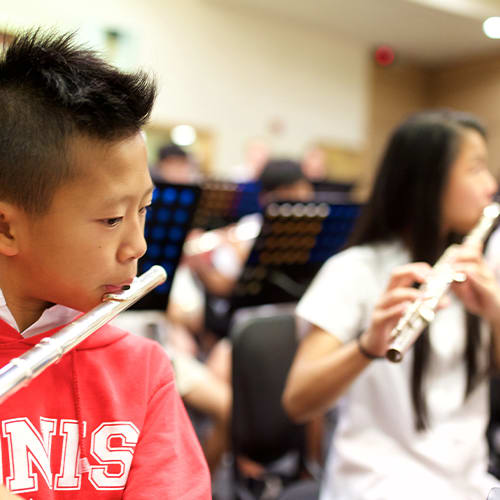
Students create and perform music to express feelings, ideas, and understanding. They develop music appreciation by exploring a variety of genres and styles from past and present and building an understanding of their contexts.
PYP, Grade 1-3
Demonstrate an understanding of a variety of musical genres and styles from the past and present, and their social and/or community contexts.
• identify reasons why people make music in their daily lives
• identify a variety of musical forms or pieces from different communities, times, and places
PYP, Grade 4-5
Demonstrate an understanding of a variety of musical genres and styles from the past and present, and their social and/or community contexts.
• identify the role of music in a community today and compare it to its role in a community of the past
• demonstrate an awareness of the characteristics of musical forms and traditions of diverse times, places, and communities
MYP, GRADE 6-8
Demonstrate an understanding of a variety of musical genres and styles from the past and present, and their sociocultural and historical contexts.
• analyze the influences of music and the media on the development of personal and cultural identity
• analyze some historical, cultural, and technological influences on style, genre, and innovation in music
MYP, Grade 9-10
Demonstrate an understanding of how traditional, commercial, and art music reflect the society in which they were created and how they have affected communities or cultures.
• explain the origins of traditional, commercial, or art music with reference to the culture or community in which it was created highlighting individual artists
• explain the ways in which traditional, commercial, and art music function in and
influence community or cultural rituals and celebrations
Dance

Dance
Students use the creative process to communicate feelings and ideas through engaging with different dance forms, traditions, and styles. They also use the critical analysis process to evaluate various dance pieces and experiences.
PYP, Grade 1-3
Apply the creative process to the composition of simple dance phrases, using the elements of dance to communicate feelings and ideas.
• use movements that are part of their daily experience
• use dance as a language to express feelings and ideas
PYP, Grade 4-5
Apply the creative process to the composition of simple dance phrases, using the elements of dance to communicate feelings and ideas.
• translate into dance a variety of movement sequences
• use the elements of energy and time in a dance piece to communicate an idea
MYP, GRADE 6-8
Apply the creative process to the composition of short dance pieces, using the elements of dance to communicate feelings and ideas.
• create dance pieces to respond to issues that are personally meaningful to them
Visual Arts

Visual Arts
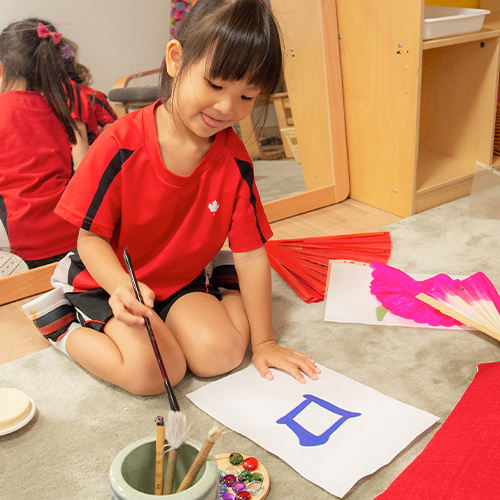
Students use the creative process to communicate feelings and ideas through engaging with different art forms, traditions, and styles. They also use the critical analysis process to evaluate various art pieces and experiences.
PYP, Grade 1-3
Demonstrate an understanding of a variety of art forms, styles, and techniques from the past and present, and their social and/or community contexts.
• experience a growing range of art forms, styles and techniques and begin to experiment focusing on different social/community contexts
PYP, Grade 4-5
Demonstrate an understanding of a variety of art forms, styles, and techniques from the past and present, and their social and/or community contexts.
• research, reflect and make connections to express one 's creative voice in response to a variety of art forms, styles and techniques and their social/community context
MYP, GRADE 6-8
Apply the creative process to produce art works in a variety of traditional two- and three-dimensional forms, as well as multimedia art works, that communicate feelings, ideas, and understandings, using elements, principles, and techniques of visual arts as well as current media technologies.
• demonstrate an understanding of composition, using selected principles of design to create narrative art works or art works on a theme or topic
• use elements of design in art works to communicate ideas, messages, and understandings
• use a variety of materials, tools, techniques, and technologies to determine solutions to design challenges
MYP, Grade 9-10
Produce art works, using a variety of media/materials and traditional and/or emerging technologies, tools, and techniques, and demonstrate an understanding of a variety of ways of presenting their works and the works of others
• experiment with dry and wet media to explore drawing, painting printmaking and sculpture
• use appropriate practices to prepare their art works for group presentation including mounting and labelling
Diploma Programme; Grade 11-12
Students may opt to study an additional Sciences, Individuals and Societies, or Languages course, instead of a course in The Arts.
Film SL/HL

The Film course aims to develop students as proficient interpreters and makers of film texts. Through the study and analysis of film texts, and through practical exercises in film production, the film course develops students’ critical abilities and their appreciation of artistic, cultural, historical and global perspectives in film. Students examine film concepts, theories, practices and ideas from multiple perspectives, challenging their own viewpoints and biases in order to understand and value those of others.
Music SL/HL
Theatre SL/HL
Visual Arts SL/HL
The Visual Arts course encourages students to challenge their own creative and cultural expectations and boundaries. It is a thought-provoking course in which students develop analytical skills in problem-solving and divergent thinking while working towards technical proficiency and confidence as art-makers.