

Mandarin
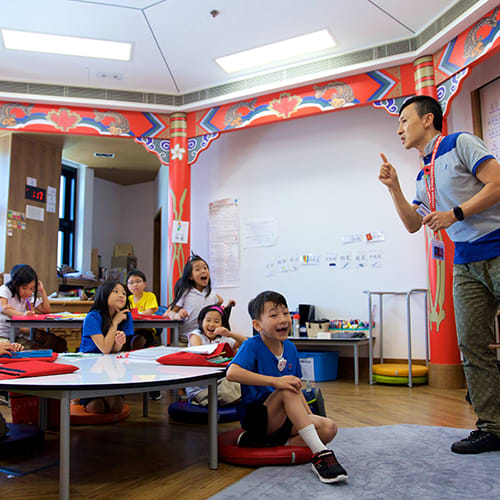
Our Chinese Studies department is committed to promoting the joy of learning Mandarin language and Chinese culture, equipping students in effective communication with local and global communities, and preparing them for the world stage. Our department recognizes the importance of Chinese language and culture in fostering economic and diplomatic collaboration between China and other countries.
We believe that a deep understanding and appreciation of Chinese traditions, history, and values can foster cross-cultural understanding and promote empathy and respect for different cultures, providing unique insights and perspectives.
We offer a rigorous and challenging curriculum, personalized learning opportunities, immersion experiences, and a range of co-curricular activities. These opportunities allow our students to apply their language skills in real-world contexts and prepare them to become effective global citizens.


Mandarin Curriculum

Early Years
Early Years & Preparatory

OVERVIEW
Students develop early Mandarin literacy skills through exploring objects and ideas, sounds and symbols while interacting. Students participate in shared reading and writing with their teachers.
EARLY YEARS 1-2
Use Chinese language to identify and explore in their environment, question and inquire, and interact with peers and teachers in order to initiate and explore relationships.
Preparatory
Communicate with others in a variety of ways, for a variety of purposes, and in a variety of contexts.
• use gestures, actions, body language and/or words to communicate needs and to express ideas, naming classmates, teachers and familiar classroom and playground objects
• join in with poems, rhymes, songs and repeated phrases in shared books
• realize that people speak different languages
Grade 1-10
Listening

Listening
Students accurately interpret messages while interacting in Mandarin with diverse audiences for a variety of purposes, with an understanding of cultural influences and sociolinguistic conventions.
PYP, Grade 1-3
Listen in order to understand and respond appropriately in a variety of situations for a variety of purposes.
• understand simple questions and respond with actions or words
• listen to and enjoy stories read aloud, showing understanding by responding
• obtain simple information from accessible spoken texts
PYP, Grade 4-5
Listen in order to understand and respond appropriately in a variety of situations for a variety of purposes.
• listen to oral texts showing understanding by responding in oral, written or visual form
• obtain simple information from accessible spoken texts
• predict likely outcomes when listening to texts read aloud
MYP, GRADE 6-8
Determine meaning in a variety of oral texts in Mandarin, using a range of listening strategies,
• identify some strategies and use them to understand simple oral texts about matters of personal interest and familiar topics, with some contextual and visual support
• identify explicit and some simple implicit information, analyse conventions and connections in simple and a few complex authentic texts (e.g., preview a vocabulary list to predict the topic of an announcement)
MYP, Grade 9-10
Determine meaning in a variety of oral texts in Mandarin, using a range of listening strategies.
• outline a range of strategies and use them to understand more simple and complicated oral texts (e.g., make and verify predictions about the content of a song read aloud to confirm understanding)
• understand information about matters of personal interest and familiar topics, with limited contextual and visual support (e.g., follow oral directions to find a specific classroom object)
Speaking

Speaking
Students communicate information and ideas through spoken interactions in Mandarin, demonstrating an understanding and appreciation of cultural values in Mandarin-speaking communities.
PYP, Grade 1-3
Use speaking skills and strategies appropriately to communicate with different audiences for a variety of purposes.
• interact effectively with peers and adults in familiar social settings
• use oral language to communicate during classroom activities, conversations and imaginative play
• memorize and join in with poems, rhymes and songs
PYP, Grade 4-5
Use speaking skills and strategies appropriately to communicate with different audiences for a variety of purposes.
• use grammatical rules of the language(s) of instruction (learners may generalize at this stage)
• describe personal experiences
• retell familiar stories in sequence
MYP, GRADE 6-8
Participate in spoken interactions in Mandarin for a variety of purposes and with diverse audiences.
• identify and use some conversation strategies to suit different structured, guided, formal, and informal situations while participating in simple and some complex spoken interactions (e.g., use nonverbal cues such as body language and eye contact to highlight important points in a conversation)
• engage in brief, semi-structured interactions about matters of personal interest and familiar topics, with teacher modelling and support (e.g., ask a peer about likes and dislikes)
• describe some strategies they found helpful to communicate effectively and describe their areas of greater and lesser strength as speakers, and plan steps they can take to improve their speaking skills (e.g., describe in a student-teacher conference how they self-monitor their speaking skills)
MYP, Grade 9-10
Participate in spoken interactions in Mandarin for a variety of purposes and with diverse audiences.
• outline and use a range of conversation strategies to suit a variety of structured, guided, formal, and informal situations while participating in simple and complex spoken interactions (e.g., use non-verbal cues such as facial expressions and gestures to clarify meaning)
• engage in semi-structured interactions about a range of academic and familiar topics, with teacher modelling and support (e.g., ask and respond to questions on learned topics)
• develop their areas of greater and lesser strength as speakers by planning steps they can take to improve speaking skills (e.g., use the most helpful strategies to consolidate speaking skills)
Reading

Reading
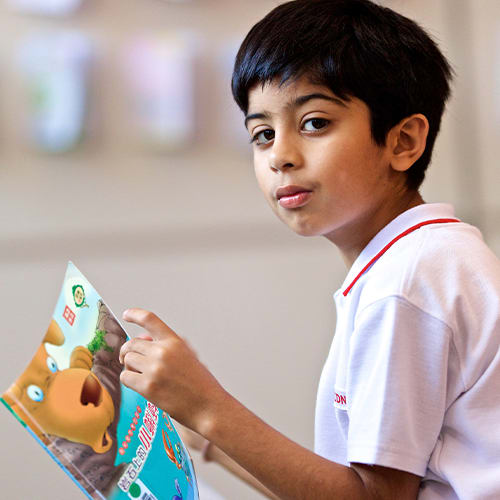
Students develop comprehension skills and cultural awareness using a range of strategies to determine meaning in a variety of text forms from diverse communities where Mandarin is spoken.
PYP, Grade 1-3
Read and demonstrate an understanding of a variety of literary, graphic, and informational texts, using a range of strategies to construct meaning.
• read and understand the meaning of self-selected and teacher-selected texts at an appropriate level
• show curiosity and ask questions about pictures or text
• locate and respond to aspects of interest in self-selected texts (e.g., pointing, examining pictures closely, commenting)
PYP, Grade 4-5
Read and demonstrate an understanding of a variety of literary, graphic, and informational texts, using a range of strategies to construct meaning.
• read and understand the meaning of self-selected and teacher-selected texts at an appropriate level
• make predictions about a story, based on their own knowledge and experience; revise or confirm predictions as the story progresses
• discuss their own experiences and relate them to fiction and non-fiction texts
MYP, GRADE 6-8
Determine meaning in a variety of texts in Mandarin, using a range of reading comprehension strategies.
• identify and use a range of strategies to understand simple and some complex texts, in modelled, shared, guided, and independent reading contexts (e.g., make connections between personal experience and the overall message of a text to extend their understanding)
• read texts that contain familiar basic and a few advanced vocabulary and expressions at a sufficient rate and with sufficient ease to demonstrate that they understand the overall sense of the text (e.g., smoothly articulate high-frequency words and familiar words while reading aloud)
MYP, Grade 9-10
Determine meaning in a variety of texts in Mandarin, using a range of reading comprehension strategies.
• outline and use a range of strategies to understand simple and complex texts, and interpret information in increasingly complex texts (e.g., use anticipation guides to predict and verify text content)
• read simple and complex texts that contain familiar vocabulary and expressions and use strategies to identify and understand explicit and implicit information (e.g., identify and record key information and supporting details from brochures or posters)
Writing

Writing
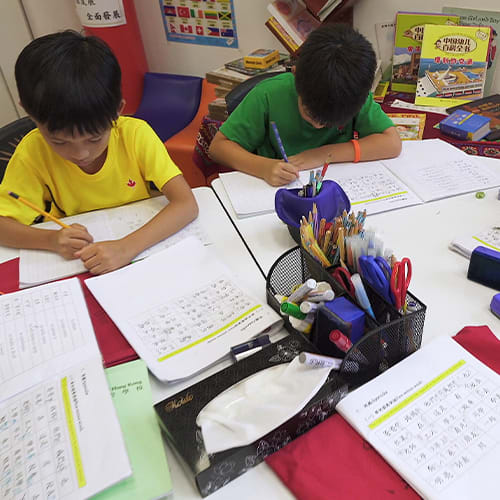
Students develop and refine their writing skills for different purposes and audiences, using appropriate sociolinguistic conventions when writing for Mandarin-speaking audiences.
PYP, Grade 1-3
Draft and revise their writing, using a variety of informational, literary, and graphic forms and stylistic elements appropriate for the purpose and audience.
• write an appropriate number of frequently used words
PYP, Grade 4-5
Draft and revise their writing, using a variety of informational, literary, and graphic forms and stylistic elements appropriate for the purpose and audience.
• write an increasing number of frequently used words or ideas independently
• demonstrate an awareness of the conventions of written text, for example, sequence, spacing, directionality
MYP, GRADE 6-8
Write texts in Mandarin for different purposes and audiences, using a variety of forms and knowledge of language structures and conventions of the written language appropriate for this course.
• state, with support from the teacher, their purpose and audience for writing (e.g., to compose an email inviting friends to a party) and communicate most of the required information with a clear sense of audience and purpose to suit the context
• use language structures and conventions, writing a variety of texts, to communicate their intended meaning in written work (e.g., diary to demonstrate personal reflections) using a range of basic and some advanced vocabulary and grammatical structures generally accurately
MYP, Grade 9-10
Write texts in Mandarin for different purposes and audiences, using a variety of forms and knowledge of language structures and conventions of the written language appropriate for this course.
• outline their purpose and audience for writing a variety of level-appropriate paragraphs and texts, applying their knowledge of basic and various complex structural and stylistic elements of each form (e.g., to prepare for a class discussion about a fictional character by creating a word web)
• use level-appropriate language structures and diverse conventions to communicate their intended meaning in written work (e.g., a product manual with steps, techniques, diagrams, and captions)
Diploma Programme; Grade 11-12
As part of the Diploma Programme (DP), students take at least one subject from studies in language and literature. Taking two studies in language and literature subjects in different languages is one way of obtaining a bilingual diploma.
Language AB Initio SL
Language B SL/HL
Language and Literature SL/HL

The course is organized into three areas of exploration and seven central concepts, and focuses on the study of both literary or non-literary texts. Together, the three areas of exploration of the course allow the student to explore the language A in question through its cultural development and use, its media forms and functions, and its literature. Students develop skills of literary and textual analysis, and also the ability to present their ideas effectively. A key aim is the development of critical literacy.
Literature SL/HL

The course is organized into three areas of exploration and seven central concepts, and focuses on the study of literary works. Together, the three areas of exploration of the course add up to a comprehensive exploration of literature from a variety of cultures, literary forms and periods. Students learn to appreciate the artistry of literature, and develop the ability to reflect critically on their reading, presenting literary analysis powerfully through both oral and written communication.